Walk behind a corn combine and watch the residue come out. If it lands in a strip instead of spreading, the reflex is to price a set of straw chopper knives before anything else gets a look. That order costs money, and the knives are usually the wrong buy. They go on, the machine sounds the same, and the strip is still there in the next field.
Cutting is one job. A straw chopper carries a series of flails or knives mounted on a horizontal shaft or drum, rotating at a relatively high speed, and that row sets how fine the residue comes out. Where it goes is a second job, handled by deflector fins that distribute the chopped material over a wider swath to the sides and behind the combine. A third part, the chaff pan or chaff pan extension, makes sure all the chaff from the cleaning shoe reaches the distributor rather than dropping to the ground in front of the axle. Cutting, placement, routing. A ragged strip behind the machine can come from any of the three, and only one of them is the knife row.
Where a straw chopper problem usually isn't
The question worth asking after a bad pass is which job failed, not which part looks old. Read the pattern: a strip that runs straight out the back and stays narrow is a placement result, and placement belongs to the fins. A pattern that reads thin or patchy right behind the axle is a routing result. Coarse chop, long pieces lying in the windrow, is the one that points at the knife row. Knives bought for a placement or routing problem are work done upstream of the cause, and the strip survives the repair.
Imagine the opposite pass: a wide, even spread of long, unbroken stalks. The fins are doing their job on material the knife row never cut down to size, so the fins are not the problem and a sharper row is the change worth making. Same rear view, opposite verdict, and the difference is in the length of what is lying there.
The knife row also happens to be the part an operator can see from the ladder, and the part that gets sold as a set. That visibility explains a good share of the blame it carries for everything coming out the back.
Inspect the knife row before you spend
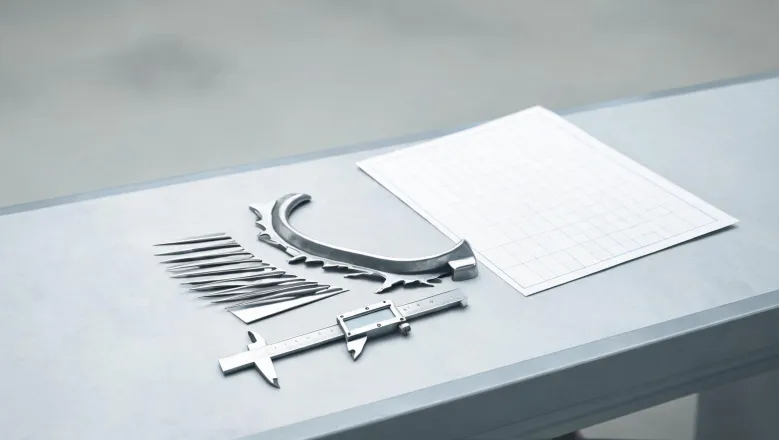
Suppose I pull the knife set on a machine that's throwing a strip, working on the guess that the row is tired. The pieces come off and go down on a flat trailer bed in the order they came off the shaft. From there the comparison is piece against piece, not piece against a spec sheet I don't have in the truck.
Three things get looked at. A bent or missing section, which is visible the moment the set is laid out. Edge wear that runs unevenly across the row, some knives rounded off while their neighbors are still square. Mounting holes that have elongated or wallowed, the failure that stays hidden until the knife is off the machine.
The row is a set on one shaft, and one bad knife changes the balance of that rotating group, which is why the row-wide comparison tells you more than a knife-by-knife one. What this check cannot hand you is a wear limit or an interval, because none came with the material behind it. The check stops at the hardware. Anything that involves the rotor itself is a question for that machine's own manual, and the answer does not transfer between models.
Test the spread, not the sound
Lay trays across the width behind the machine. Mark a board in three zones. Left, center, right. Make one short pass in uniform crop. Hold the speed steady. Then read the catch.
Read the zones against each other, not against the sound of the chopper and not against a glance in the mirror. The material leaves through the deflector fins, and those fins are what spread it to the sides and behind the machine, so the pattern on the ground is a direct read on the fins.
Suppose I run that pass twice, once at the ground speed the operator normally uses and once a gear lower, and the left zone fills in on the second pass while the right stays light. That reading points at the fins and at the speed, and the knives are still a question nobody has asked yet.
A shift in wind direction across the pass, a wetter or heavier crop than the one the machine was set up for, or a single visibly bent or blocked fin can flatten or shift that pattern until it looks like a knife problem even though every knife in the row is still cutting clean, and that is the moment the spread reading overturns the knife conclusion and sends the next hour to the fin bank and to the pass conditions instead.
No tray counts, no distances, no percentage targets. The fin function is described in general terms and no numbers come attached, and a made-up number on a spread check is worse than no number at all.
The chaff pan nobody thinks to look at
The chaff pan rarely gets pulled and almost never gets priced, and it can make a healthy chopper look sick. Its job is to see that the chaff from the cleaning shoe reaches the distributor rather than falling to the ground ahead of the axle.
Take the pan out of the picture, cracked or missing or an extension that should be fitted and isn't, and what falls behind the combine stops being a clean read on anything upstream. Some of what the operator watches hit the ground never reached the distributor at all. The pattern reads thin or uneven exactly where the pan should be carrying material, and the knife row takes the blame for a routing failure it had no part in.
Which pan a given machine carries, and whether an extension is fitted, is a parts-catalog question for that machine. The function travels; the part does not.
Worn knives or worn fins, which comes first
On a machine with a tired knife row and a fin bank that has been bent, blocked or set wrong, I would spend on placement first. Comparing knives with fins comes down to position in the line: the fins sit downstream of the knives, so they can undo a good cut, while a sharp row behind bad fins still throws a strip. That asymmetry settles the order for me.
Then the question of which one is cheaper to be wrong about. Fins ask for patience and an adjustment. A knife set costs money and time on the rotor, and if the fins were the cause, the pattern is unchanged and the old knives were never the problem. Unlike the fins, the knives tend to announce themselves in chop quality first; my read is that a dulling row shows up in how fine the residue is before it shows up in where the residue lands.
Compared with both, the chaff pan explains a slice of the visible pattern that neither knives nor fins account for, and it is the cheapest of the three to check, because you can look at it without pulling anything off the shaft. Both knives and fins get the attention. The pan gets a glance at best.
Fix placement before sharpness, unless the row is visibly broken. A bent or missing knife is a repair, and a repair is not a diagnosis.
Confirm the knife mounting before you order
Before a knife goes in the cart, match the knife series and the mounting to the specific machine through that machine's own parts catalog. What is known in general is a series of flails or knives on a horizontal shaft or drum. Hole pattern, count, length, fitment for a given rotor: none of that comes with the general description, and no model, serial or cross-reference list sits behind this article.
That is why this check comes last in the day but first in importance, ahead of price and ahead of brand. Price is the easy comparison, because listings sit side by side. Fitment decides whether any of the diagnosis above is worth acting on. A knife that looks right lying next to the one that came off is still unconfirmed for that rotor, and until the catalog settles it, the residue behind the machine keeps its old explanation.

Leave a procurement question
Keep confidential drawings and company purchasing information out of public comments; send those through a sourcing inquiry.